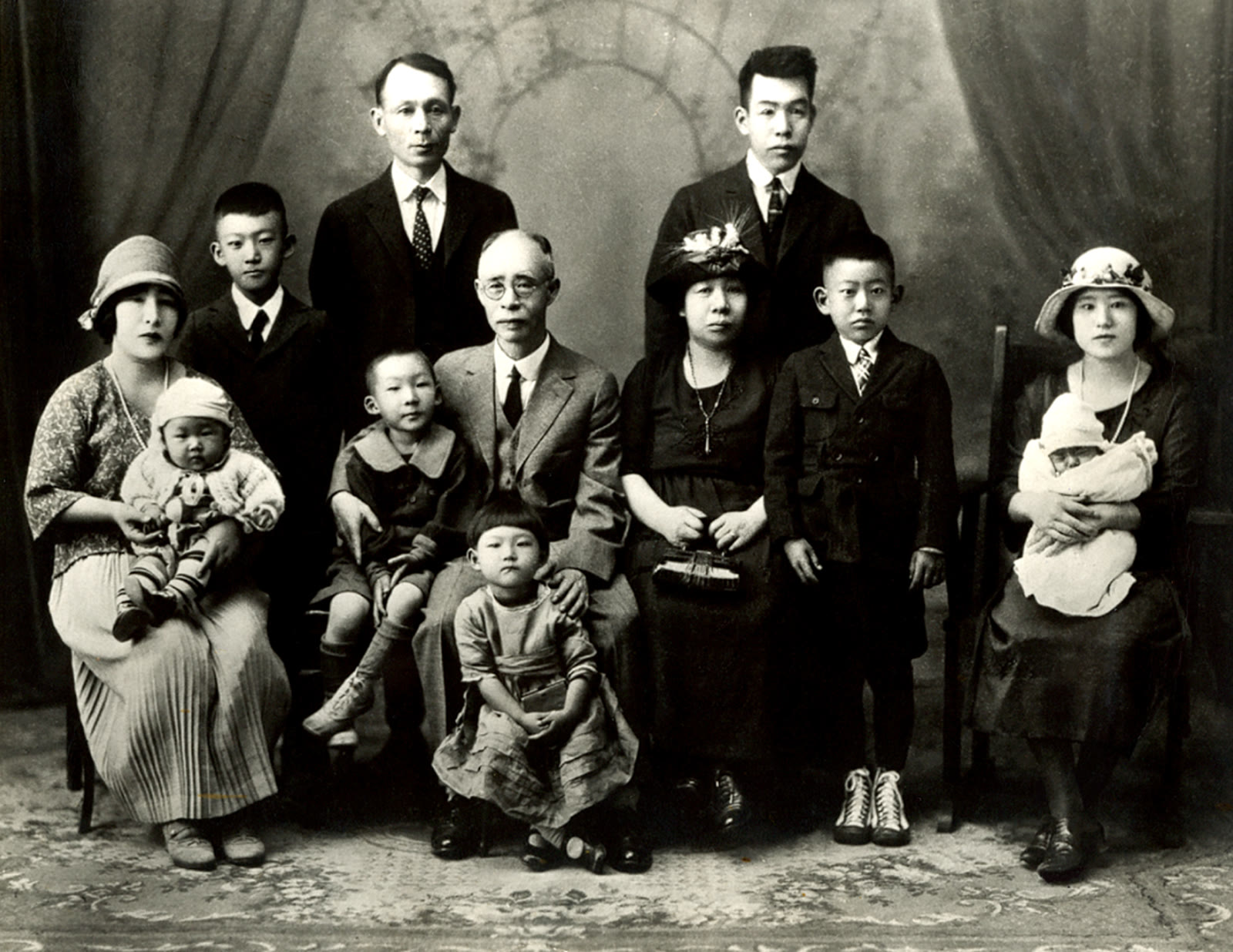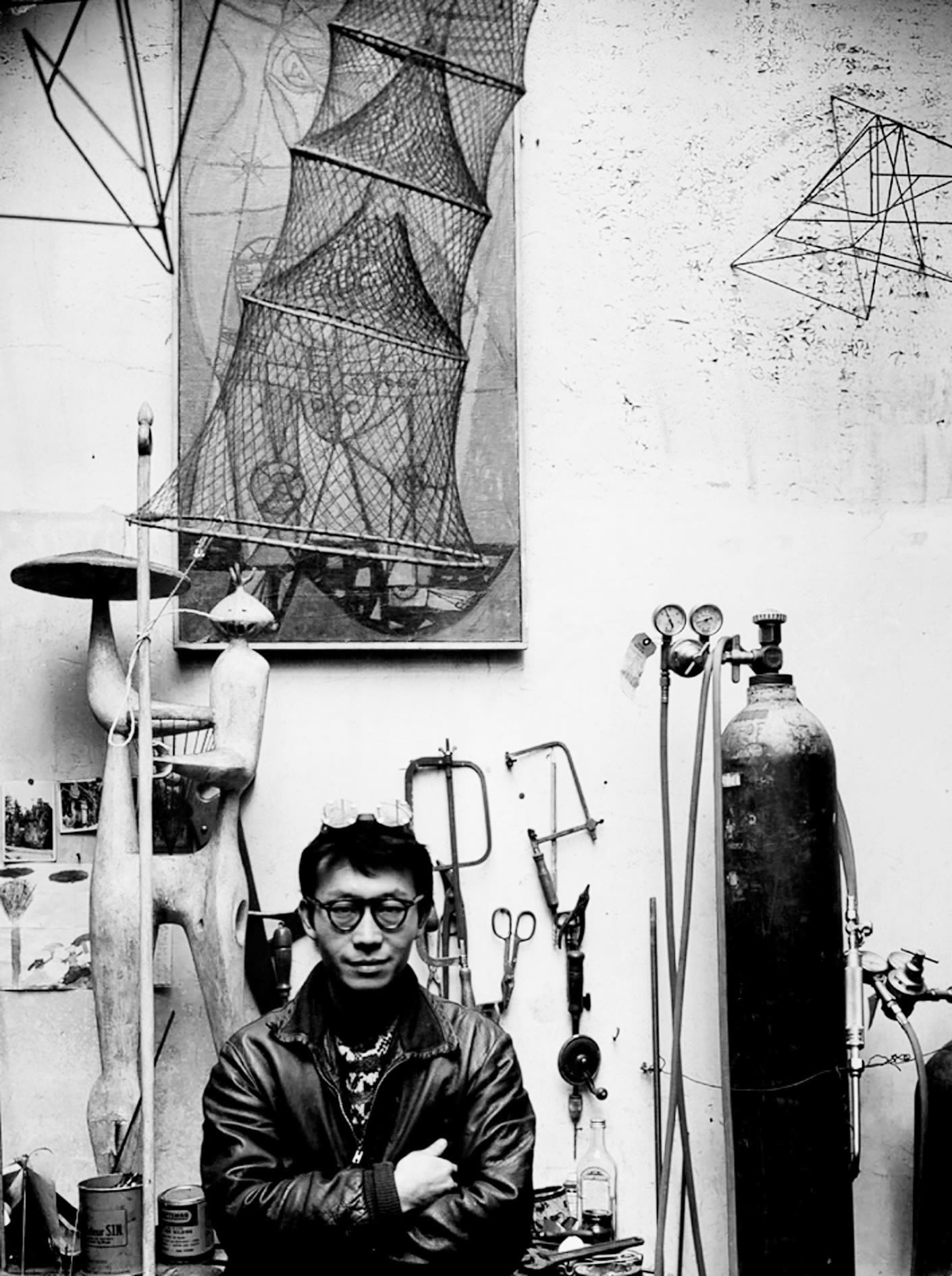

Born 7 December in Watts, Los Angeles, the fifth of seven children of Ryukichi Tajiri and Fuyo Kikuta, who emigrated from Japan to the United States in 1906 and 1913.
The family moves to San Diego.
His father Ryukichi Tajiri passes away on 18 April.
Takes lessons from sculptor Donal Hord in San Diego, in exchange for weeding his cactus garden.
On 7 December, his 18th birthday, Japan attacks Pearl Harbor.
Following Executive Order 9066 he is interned with some 120,000 Japanese-Americans: in May in the horse stables of the Santa Anita racetrack, in September in Poston 3 camp in Arizona.
Volunteers for the 442nd Regimental Combat Team, a unit of Japanese-American volunteers. Basic training at Camp Shelby, Mississippi.
Shipped to Italy with the 442nd; liberation of Rome. Wounded at Castellina on 9 July and spends six months in the military hospital in Rome. Then serves in France with the army postal service.
As an army artist in Seckenheim, Germany, he draws displaced persons from Eastern Europe in Mannheim. On leave in Paris.
After demobilisation on 9 January he settles in Chicago with his mother, brothers and sister and works as a restorer in a Japanese antiques shop. Receives the Purple Heart. Works on Father and Son.
Works in August and September as assistant to Isamu Noguchi at his New York studio, on Avatar among other works. Takes a year-long course at the Art Institute of Chicago on the GI Bill.
Leaves for France and arrives in Le Havre on 28 September. Studies in Paris with Ossip Zadkine at the Académie Colarossi and lives in Clamart. Through Simon Vinkenoog, a model at Zadkine’s, he gets to know the CoBrA artists; CoBrA is founded on 8 November. Makes the first work in a lifelong series of Warriors, Samurai and Sentinels.
Studies with Fernand Léger until September 1950. Takes part in the 1st International Exhibition of Experimental Art (CoBrA) at the Stedelijk Museum Amsterdam and, in 1951, in its sequel at the Palais des Beaux-Arts in Liège. Makes One-Day Sculptures along the Seine, photographed by Sabine Weiss and published in LIFE in 1952.
Co-founds Galerie Huit for American artists in Paris; Picasso visits the exhibition and singles out his sculptures for praise. Studio on the rue d’Odessa in Montparnasse, studies at the Académie de la Grande Chaumière. Begins the Junk sculptures; he learns welding from the Danish sculptor Robert Jacobsen.
Designs a cover for a novel by Henry Miller with photographs by Brassaï. Henri Matisse selects him with three other sculptors for the Salon des Jeunes Sculpteurs, designed by Le Corbusier. Marries Denise Martin on 25 May. The GI Bill stipend ends; from December guest lecturer at the Werkkunstschule in Wuppertal and designer at the Rasch Tapetenfabrik in Bramsche.
Studio at the Impasse Ronsin in Paris, alongside Constantin Brancusi, Max Ernst, Jean Tinguely, Eva Aeppli and Niki de Saint Phalle.
Meets Ferdi Jansen; they start living together in a studio in the courtyard of the Académie Colarossi and later in Sucy-en-Brie. Wins first prize for the best German wallpaper at the International Wallpaper Exhibition in Darmstadt.
Divorced from Denise Martin on 13 May. Moves with Ferdi to the rue Vercingétorix in Paris; together they travel on a Triumph 650 through Spain, North Africa, Belgium, the Netherlands, Austria and Italy.
Makes the film The Vipers, awarded the Golden Lion for the best use of the language of film at the 8th International Festival for Amateur Films in Cannes. Makes the film Ferdi and designs the cover of Samuel Beckett’s Molloy.
Moves with Ferdi to Amsterdam, Oudezijds Achterburgwal 151. AVRO broadcasts his film Ferdi.
Marries Ferdi; their daughter Giotta Fuyo is born on 6 June. Invents the Molar brick technique for bronze casting.
Begins the Drippings series. The family moves to a house with studio at Valkenburgerstraat 150–152 in Amsterdam.
Founds the short-lived avant-garde group A’dam with Wessel Couzijn, Hans Verhulst, Ben Guntenaar and Carel Kneulman. Receives a sculpture grant from the William and Noma Copley Foundation, with Marcel Duchamp, Max Ernst and Hans Arp on the jury. Participates in Documenta II. Their daughter Ryu Vinci is born on 25 April.
Begins working with tubular brass elements. Receives a grant from the John Hay Whitney Foundation in New York.
Installs the AKU Fountain sculpture on Gele Rijdersplein in Arnhem.
The family moves to Kasteel Scheres in Baarlo and participates in the Venice Biennale.
Wins the Mainichi Shimbun Prize for sculpture at the Tokyo Biennale and the gold medal at the San Marino Biennial. Spends six weeks in Japan and travels around the world.
Karl Kleimann from Dortmund and Isamu Kanamori from Tokyo become his assistants at Kasteel Scheres; Kleimann remains so for the rest of his life. Group exhibition at the Stedelijk Museum Amsterdam alongside Calder, César, Chadwick, Gabo and Richier. Participates in Documenta III. Guest professor at the Minneapolis School of Art at the invitation of director Arnold Herstand; lives in Minneapolis for a year with family and assistants.
Makes Column for Meditation, a monumental sculpture for the city of St. Paul, Minnesota. Travels for five months through the United States and Mexico with family and assistants.
Begins the Machines series, which ends in 1968 with number 8. Records the Baarlo carnival with friends and daughters on videotape, his first video recordings.
Designs the first Knot, beginning a long series of Knots in various materials and scales.
Participates in Documenta IV and, with Ferdi, Wessel Couzijn and Pearl Perlmutter, in 2 couples, 4 sculptors at the Technical University Eindhoven. Works on the Machine sculptures series. In the autumn Ferdi undergoes major surgery in Switzerland.
Ferdi passes away on 2 February. Nelson Rockefeller purchases a sculpture for the Museum of Modern Art in New York. At the students’ request, guest professor at the Hochschule der Künste in Berlin; from 1973 to 1989 he holds a professorship there.
Suzanne van der Capellen moves to Kasteel Scheres.
Grand Prix for the film Bodil Joensen – A Summer Day at the 1st Wet Dream Film Festival in Amsterdam. Begins a three-year series of video interviews with artists and reports made with the portable video pack.
Returns to the Minneapolis College of Art and Design as a guest lecturer; sets up a video workshop and an Electronic Bulletin Board there. His mother Fuyo passes away.
Revives the daguerreotype and begins a series of over a thousand daguerreotypes: contemporary photographs on silver plates. Appointed professor at the Hochschule der Künste in Berlin.
Installs the knot Meeting Point at Schiphol Airport and begins experimenting with stereoscopic photography.
Marries Suzanne van der Capellen on 27 September.
Makes Homage to Magritte, an installation with stereo photographs.
The monumental Friendship Knot is installed in Little Tokyo, Los Angeles. Becomes honorary citizen of Los Angeles and receives the Key to the City from mayor Tom Bradley.
Travels to China with sixteen students of the Hochschule der Künste; meetings and exhibitions at art schools.
Makes drawings of knots on the Commodore Amiga computer.
Retires from the Hochschule der Künste in Berlin after twenty years; the students bid him farewell with an exhibition.
Appointed Knight in the Order of Orange-Nassau on 29 May. His first grandchild, Tanéa Fuyo, daughter of Giotta and Terry Roberts, is born on 29 September.
Honorary citizen of Bruyères in the Vosges, France. Begins a series of films on a digital camera and makes compilation films on the computer. His grandson Shakuru Shin is born on 13 December.
Designs the dry Zen garden Karesansui for Museum Cobra, Amstelveen.
Begins the Ronin series.
Establishes Tasha BV, named after his grandchildren Tanéa and Shakuru.
Becomes a member of the Académie Royale in Brussels, following his nomination in 2000.
Honorary citizen of the municipality of Maasbree, of which Baarlo is part.
On 2 May Queen Beatrix unveils the four Sentinels on the Maas bridge in Venlo. Appointed Knight in the Order of the Netherlands Lion.
Receives Dutch citizenship on 7 December.
Passes away on 15 March in his studio at Kasteel Scheres, Baarlo, among his family.
Posthumously receives the Congressional Gold Medal, the highest civilian award in the United States, for his service in the 442nd Regimental Combat Team.
Made in USA by Tajiri and Womb Tomb by Ferdi take a permanent place in the collection of the Rijksmuseum in Amsterdam, reopened on 15 April.